Payments
Payments space continues to attract big investment in H1’22
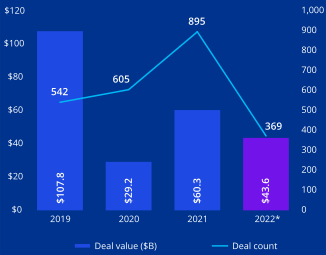
Total global investment activity (VC, PE and M&A) in payments 2019–2022*
Source: Pulse of Fintech H1'22, Global Analysis of Investment in Fintech, KPMG International (data provided by PitchBook), *as of 30 June 2022.
Investment in the payments space remained very strong in H1’22, accounting for $43.6 billion in investment compared to the $60.3 billion seen during all of 2021. The acquisition of Australia-based Afterpay by Block (formerly Square) for $27.9 billion accounted for the largest payments deal of the quarter — and the largest fintech deal globally during H1’22 — followed by the $2.6 billion buyout of Bottomline Technologies by PE firm Thomas Bravo, and a $1 billion VC raise by UK-based Checkout.com.
What to watch for in H2'22
- Potential down rounds as some payments companies seek to raise capital at lower valuations
- Further consolidation as payments companies look to survive and better distinguish themselves from the competition
- Continued focus on open banking and embedded finance, and on fintechs able to enable a more integrated and frictionless customer experience
“Most challenger banks will continue to expand into new markets and roll out new products and services in 2022, despite increased funding difficulties and some regulatory challenges in different jurisdictions. If they want to be successful, however, challenger banks will really need to focus on ensuring they’ve considered their compliance requirements fully even amidst the rush to be relevant in the market and the industry.”
Courtney Trimble
Global Head of Payments, KPMG International
Insurtech
Slowdown in investment in insurtech sector amid global uncertainty
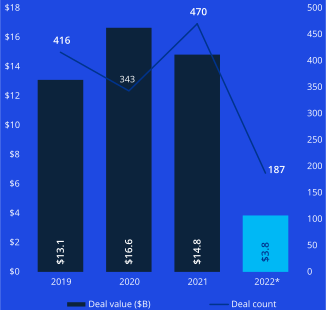
Total global investment activity (VC, PE and M&A) in insurtech 2019–2022*
Source: Pulse of Fintech H1'22, Global Analysis of Investment in Fintech, KPMG International (data provided by PitchBook), *as of 30 June 2022.
Investment in the insurtech sector dropped considerably, with $3.8 billion of investment globally during H1’22 — well off pace to match the $14.8 billion in investment seen during 2021. The largest insurtech deal of H1’22 was the acquisition of US-based Zenefits by TriNet for $220 million. This was followed by several $100 million+ VC deals, including $211 million and $200 million raises by Healthcare.com and Newfront insurance — both in the US, and a $196 million raise by France-based Alan. The Americas and Europe accounted for the vast majority of insurtech investment, with India-based Turtlemint’s $121 million raise the largest in the Asia-Pacific region.
What to watch for in H2'22
- Ongoing evolution and growth of MGAs focused on underwriting specific risks for specific types customers of that large and traditional carriers find difficult to address
- Increasing focus on customization of insurance products
- Growing focus on insurtechs looking to help companies rethink the protection of their assets and access to those assets
“I do see more appetite for early-stage businesses being founded because they are a smaller dollar opportunity and there’s more upside for a lot of those investors. Historically, we’ve seen some incredible businesses being built during economic downturns, funded by early stage seed and Series A investors. The current market environment may make it a bit more difficult to get later stage funding and relatively easier to get early stage funding — but probably not at the founder-friendly economic terms we’ve seen over the past few years.”
Ram Menon
Global Head, Insurance Deal Advisory, KPMG International
Regtech
With $5.6 billion of investment, global investment in regtech holds strong in H1’22
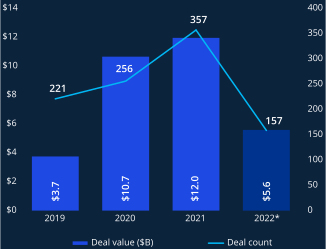
Total global investment activity (VC, PE and M&A) in regtech 2019–2022*
Source: Pulse of Fintech H1'22, Global Analysis of Investment in Fintech, KPMG International (data provided by PitchBook), *as of 30 June 2022.
Compared to a number of other areas of fintech, global investment in regtech showed strong resilience in H1’22. Globally, regtech companies attracted $5.6 billion in investment across 157 deals — following a similar trajectory to the level of investment seen in 2021. The US accounted for the largest share of regtech investment during H1’22, including the $2.6 billion buyout of Bottomless Technologies by Thomas Bravo, the $450 million Series D raise by ConsenSys, and the $240 million acquisition of FourQ by cloud-based financial operations company Blackline.
What to watch for in H2'22
- Continued development, evolution, and implementation of regulatory regimes and guidelines, such as MiCA, Basel IV, and ESG standards
- Financial system regulators widening their expectations beyond traditional banks and financial institutions to include other contributors to the capital markets — such as asset managers and challenger banks
- Increasing focus on AI-powered identity verification, KYC & AML compliance and identity proofing on order to increasingly automate the prevention and combat of fraud
“As can be seen from the top deals of 2022 so far, anti-money laundering, fraud prevention, and KYC continue to drive a lot of the investment in the regtech space. The geopolitical situation is only helping the growth of these companies, which will likely keep regtech investment strong heading into H2’22. While we’re not seeing it in the market yet, we also expect a new wave of regtech companies focused on supporting ESG reporting and compliance to emerge in the near future.”
Fabiano Gobbo
Global Head of Regtech,KPMG International
Wealthtech
Global investment in wealthtech soft in H1’22
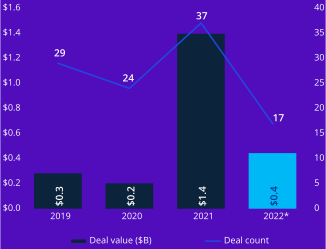
Total global investment activity (VC, PE and M&A) in wealthtech 2019–2022*
Source: Pulse of Fintech H1'22, Global Analysis of Investment in Fintech, KPMG International (data provided by PitchBook), *as of 30 June 2022.
After a very strong 2021, wealthtech investment softened considerably in H1’22, mirroring the decline in investment more broadly around the world. Globally, wealthtech attracted $440 million during H1’22, led by US-based Titan’s $100 million VC funding round, and UK-based MoneyFarm’s $59.8 million PE deal.
What to watch for in H2'22
- Increasing focus on solutions aimed at the B2B2C market.
- Consolidation across the wealth management and wealthtech ecosystem, including among advisors.
- The large transfer of wealth across generations beginning to drive innovation and the development of unique wealth management solutions
- Increasing focus on companies focused on helping traditional wealth management firms understand and use their data more effectively
- Growing focus on ESG, from an investment decision making perspective
- Burgeoning focus on leveraging open finance and embedded finance to expand wealth management opportunities
“Given the range of well-established, robust, and globally-recognized wealthtech platforms like Avaloq, InvestCloud, SS&C, and FN&Z, investors are not as interested in small scale middle or back office systems at the moment — but the front office still offers plenty of opportunities for new wave wealthtech providers to gain traction. Looking ahead to H2’22 and beyond, investments in innovative front office wealthtech solutions will be a key area to watch”
Shelley Doorey Williams,
Partner, Wealth and Asset Management ConsultingKPMG in the UK
Cybersecurity
Investor interest in cybersecurity remains hot in H1’22
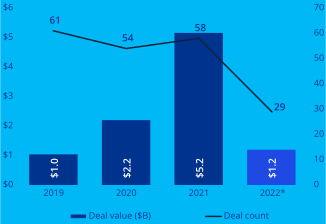
Total global investment activity (VC, PE and M&A) in fintech: cybersecurity 2019–2022*
Source: Pulse of Fintech H1'22, Global Analysis of Investment in Fintech, KPMG International (data provided by PitchBook), *as of 30 June 2022.
At the end of H1’22, global investment in cybersecurity was running well short of 2021’s record, primarily due to the lack of a completed blockbuster M&A deal similar to the $2.7 billion acquisition of Verafin in H1’21. Despite the lack of completed M&A deals, VC investor interest and investment in the cybersecurity space remained strong — led by four big raises in the US, including a $550 million raise by Fireblocks, a $170 million raise by Chainalysis, and $100 million raises by TokenEx and Cowbell Cyber. Estonia-based Veriff also raised $100 million during H1’22. The volume of cybersecurity deals globally was also very robust at mid-year, if just shy of record pace.
What to watch for in H2'22
- Increasing consolidation as companies that traditionally focused on one segment of cybersecurity (e.g., endpoint alerting) look to build out their cybersecurity offerings
- Shift in focus from MDR as a means for conducting level one ticket triage to MDR providing full stack response
- Continued focus on startups focused on extreme automation
“There’s a lot of concern out there regarding the sheer number of cybersecurity incidents — the massive amount of data coming into security operations centers through alerts if you will. There’s just so much coming in and not enough security workers out there to simply throw more bodies at the problem. This is why we’re starting to see a lot more focus on automation and machine learning. In 2021, we started to see a lot of machine-learning type algorithms make their way into cybersecurity, but now its really taking off.”
Charles Jacco
Americas Cyber Security Services,Financial services Leader, Principal, KPMG in the US
Blockchain/crypto
Investment in crypto and blockchain falls from 2021 high, remains ahead of all other years
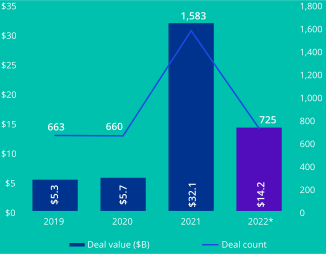
Total global investment activity (VC, PE and M&A) in blockchain & cryptocurrency 2019–2022*
Source: Pulse of Fintech H1'22, Global Analysis of Investment in Fintech, KPMG International (data provided by PitchBook), *as of 30 June 2022.
After a record-shattering 2021, global investment in crypto and blockchain fell to $14.2 billion during H1’22. Despite the crypto space collapsing significantly since mid-way through Q1’22 due to the unexpected Russia-Ukraine conflict, rising inflation, and the challenges experienced by the Terra crypto ecosystem, investment at mid-year remained well above all years prior to 2021. This highlights the growing maturity of the space and the breadth of technologies and solutions attracting investment. During H1’22, the largest deals in the space came from VC raises, including a $1.1 billion raise by Germany-based Trade Republic, a $550 million raise by US-based Fireblocks, a $500 million raise by Bahamas-based FTX, and a $450 million raise by ConsenSys.
What to watch for in H2'22
- Resilience of crypto-focused companies being tested very hard as some look to recapitalize at lower valuations
- Well managed crypto companies with healthy risk management policies, long-term vision, and strong cost and risk management approaches surviving, while others bust
- Growing focus on solutions related to compliance and crypto transaction traceability
- Increasing interest in stablecoins, particularly from corporates looking to gain the operational advantages of crypto, including costs, delays, visibility, liquidity, and ease-of-use
- Innovative partnerships between crypto firms and companies in other industries in order to address ESG concerns
“Looking ahead, we are going to see some cryptos cutting their valuations and working to raise money because it’s their only option. They’d rather raise money and be capitalized at a lower valuation rather than not doing so and taking the risk of dying out. Of course, some cryptos will die out — particularly those that don’t have clear and strong value propositions. That could actually be quite healthy from an ecosystem point of view because it’ll clear away some of the mess that was created in the euphoria of a bull market. The best companies will be the ones that survive.”
Alexandre Stachtchenko
Director Blockchain & Crypto,KPMG in France